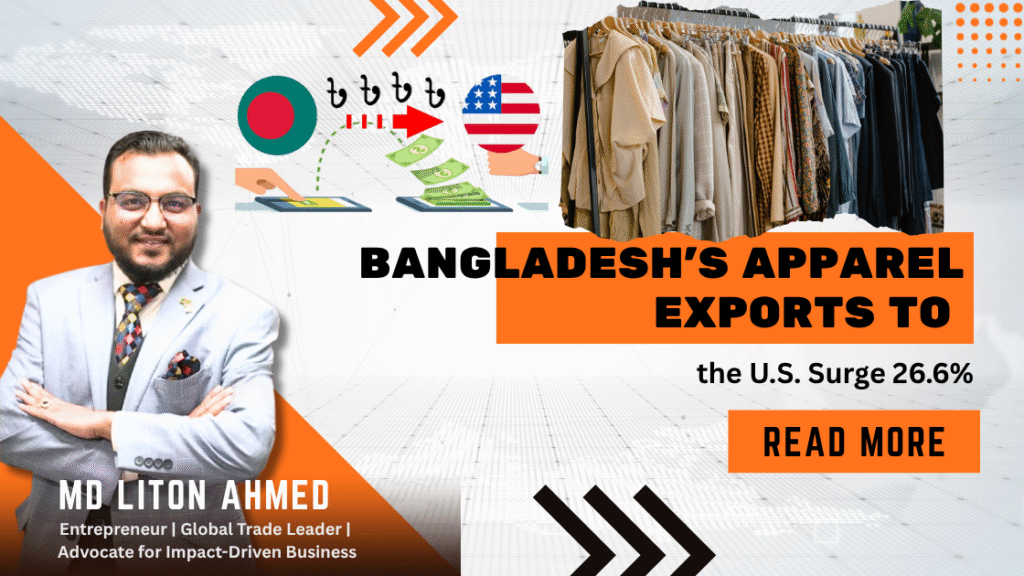
Bangladesh has once again demonstrated its growing strength in the global apparel market. In the first quarter of 2025, the country’s garment exports to the United States jumped by 26.6%, reaching approximately US $2.22 billion, according to data from the Office of Textiles and Apparel (OTEXA) under the U.S. Department of Commerce.
This sharp rise not only cements Bangladesh’s position as one of the fastest-growing apparel suppliers to the U.S. but also signals a gradual shift toward more sophisticated and higher-value garments — a transformation long awaited by industry observers.
⸻
📈 Record Growth and Rising Market Share
During January–March 2025, Bangladeshi apparel exports to the U.S. increased by over 25% in volume, with a modest but meaningful 1.12% rise in unit price. While the overall U.S. apparel import market grew at a slower pace, Bangladesh’s performance stood out, helping the nation gain market share from competitors such as China, Vietnam, and Cambodia.
In the first half of 2025, the total export value to the U.S. climbed to US $4.25 billion, up from US $3.39 billion in the same period last year — a growth of 25.13%.
⸻
👕 Transitioning from Volume to Value
For decades, Bangladesh’s apparel industry has been known for its mass-scale, cost-competitive production — particularly in basic items such as T-shirts, trousers, and sweaters. However, recent data suggest that the sector is moving up the value chain:
• Increased focus on design and innovation
• Higher-quality finishing and compliance standards
• Rising investments in modern machinery and automation
• Adoption of sustainable production practices
Industry leaders note that international buyers are now sourcing more complex and fashion-forward products from Bangladesh, from outerwear and activewear to technical fabrics and denim innovations.
⸻
🌍 Why the U.S. Market Matters
The United States remains Bangladesh’s single largest apparel export destination, accounting for nearly 20% of total garment exports. Despite tariff challenges and trade policy uncertainties, the country’s apparel sector has shown resilience, driven by strong demand from major retailers such as Walmart, H&M, Target, and Gap.
Even as the global retail environment becomes more volatile, Bangladesh continues to attract U.S. buyers through its competitive pricing, ethical compliance, and capacity to scale production quickly.
⸻
⚠ Challenges Ahead
While the export surge is impressive, sustaining it will require strategic adaptation. Several challenges remain:
• Potential tariff hikes under evolving U.S. trade policies.
• Increasing competition from Vietnam, Mexico, and Central America.
• Need for skill development to support higher-value garment production.
• Pressure from buyers for sustainability and transparency.
Without proactive investment in technology, design capabilities, and human capital, Bangladesh risks being confined to low-margin segments.
⸻
🚀 The Way Forward
To maintain momentum and deepen its foothold in the U.S. market, Bangladesh must:
1. Invest in innovation — build in-house design and R&D units.
2. Strengthen sustainability credentials — through green factories and traceable supply chains.
3. Develop skilled human resources for modern manufacturing.
4. Leverage trade diplomacy to secure favorable terms and mitigate tariff risks.
By focusing on quality, innovation, and sustainability, Bangladesh can transform from a volume-based exporter to a value-driven global apparel leader.
⸻
🧭 Conclusion
The 26.6% growth in apparel exports to the U.S. is more than just a number — it’s a reflection of Bangladesh’s evolving competitiveness. As the industry embraces modernization and value addition, the country stands on the threshold of a new chapter — one defined not just by quantity, but by quality, creativity, and global relevance.
⸻
Sources:
• Office of Textiles and Apparel (OTEXA), U.S. Department of Commerce
• Apparel Views, Textile Insights, Daily New Nation
• Reuters, Financial Times